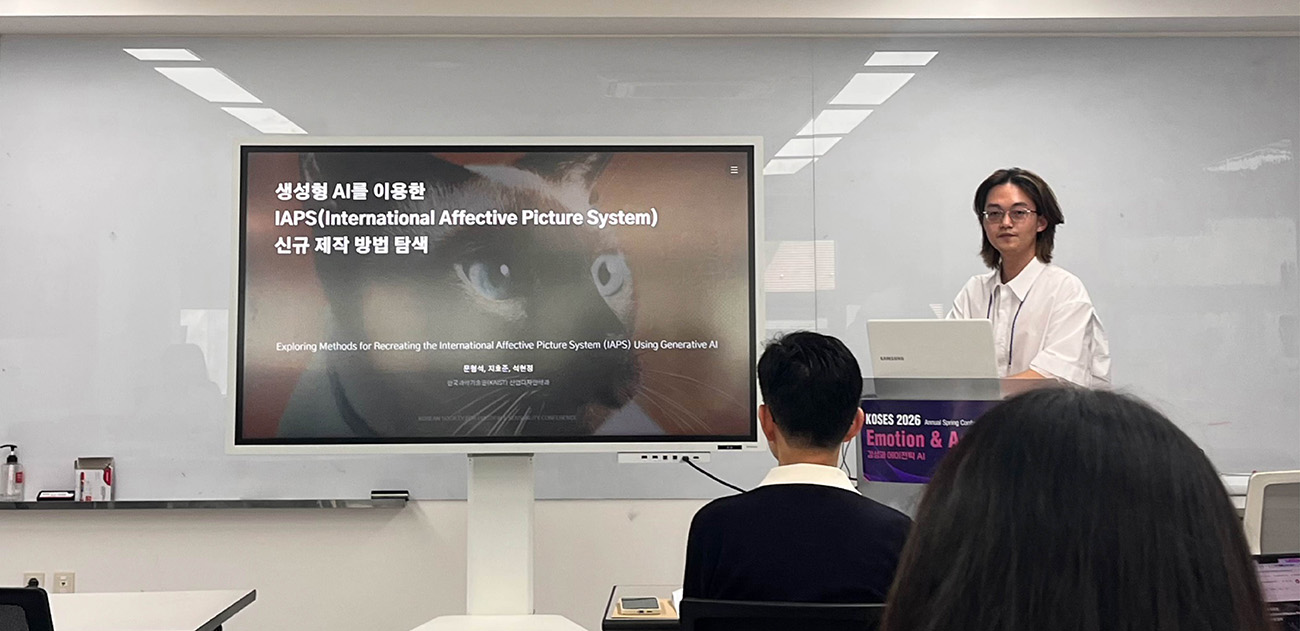
We proudly celebrate Hyungseok Moon (문형석)’s achievement, where his study, “Exploring Methods for Recreating the International Affective Picture System (IAPS) Using Generative AI,” received the Best Paper Award in the Oral Session at the Korean Society for Emotion and Sensibility. His study investigates how generative AI can be used to recreate and modernize IAPS images, while preserving the emotional characteristics originally measured through the Self-Assessment Manikin (SAM) scale.
Motivated by the visual outdatedness of many IAPS images in terms of resolution, color reproduction, photographic style, and era-specific objects, Hyungseok generated alternative images for IAPS and evaluated them. The results identified four key visual elements for affect-preserving image recreation and offers a new guideline for temporal recreation of IAPS. Congratulations to Hyungseok on this meaningful achievement!
Abstract
The International Affective Picture System (IAPS) has accumulated emotional responses (Pleasure, Arousal, Dominance) to everyday scenes using the Self-Assessment Manikin (SAM) scale. However, many IAPS images feature outdated quality or strongly reflect their era of capture, limiting their utility as standard stimuli in contemporary visual culture. This study explored modernizing IAPS images using generative AI and evaluated the preservation of their original emotional characteristics. We generated alternative images for 12 scenes evenly distributed in the PAD space and evaluated them with 30 participants. Results showed significant differences (p < 0.05) from original scores in 16 out of 36 scales. Notably, AI safety filters and automatic aesthetic corrections arbitrarily smoothed impressions or lowered the Arousal of gruesome stimuli. Analysis of open-ended feedback revealed that achieving emotional alignment requires structurally controlling four core visual elements within prompts, subject composition and proportion, light source and color temperature, raw textures, and core contextual objects. This study, which began with 12 IAPS images, necessitates repeated evaluation and verification to ultimate goal that the IAPS can sustain its role as standard material for affective research, imbued with contemporaneity while maintaining the original intent of its design and the concepts behind the collection of each photograph.